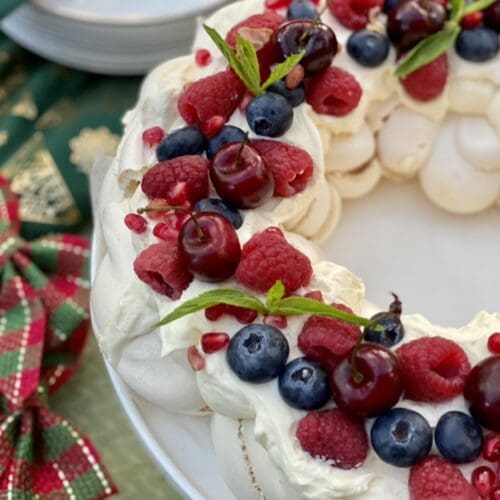
Christmas Pavlova Wreath

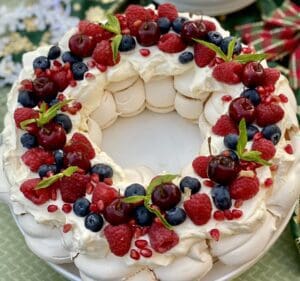
This beautiful Christmas Pavlova Wreath has an crisp shell and soft, marshmallowy centre. A stunning holiday dessert for your table!
Ingredients
Meringue
- 7 (240g / 8.5oz) large eggs (egg whites only, at room temperature) (NOTE 1)
- 2 cup (440g / 16oz) caster sugar (superfine sugar) (NOTE 2)
- 2 tbsp cornflour (or cornstarch)
- 2 tsp white vinegar
- 1 tsp vanilla extract
For the whipped cream
- 2 cups (500ml / 0.5 US qt) thickened cream (NOTE 3)
- 2 tbsp icing sugar (powdered sugar) (NOTE 4)
- 1 tsp vanilla extract
Fruit topping & garnish (swap with any fruits you like)
- raspberries
- blueberries
- cherries
- pomegranate arils
- mint leaves
Instructions
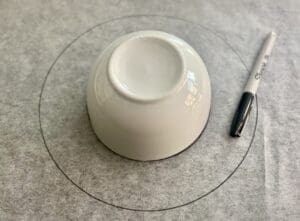
- Preheat the oven to 110°C (230°F). Make sure your equipment is free from grease, as this may prevent the egg whites from whipping up. To be safe, I like to wipe my bowls and balloon whisk with paper towels lightly dipped in vinegar.Using a round object approximately 25cm (9.8in) in diameter (I use the base of a cake tin), trace a circle onto non-stick baking / parchment paper. Use another round object about 12cm (4.7in) in diameter and trace it inside the larger circle to create a ring. Flip the paper over and place it on a large, flat baking tray.
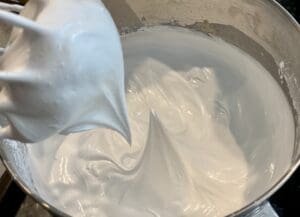
- Prepare a large piping bag fitted with a 1.5cm (0.6in) plain round nozzle.In a stand mixer or using a hand mixer, whisk the egg whites on medium-high speed with a balloon whisk attachment. Once the whites become foamy, increase the speed to high and gradually add the sugar, one tablespoon at a time. Continue whisking for 6–8 minutes, or until stiff, glossy peaks form. Add the cornflour, vinegar and vanilla extract, then whisk on high for a further 1 minute until fully incorporated.
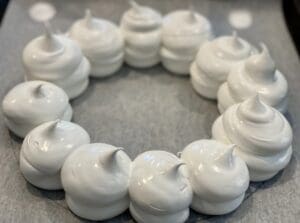
- Place the meringue into the piping bag, then secure the baking paper to the tray by using the meringue as glue in each corner. Pipe large mounds using the drawn ring as a guide. Once you've made a single layer, go over the mounds again, until you've used all the meringue (mine were three layers high). Use the back of a spoon to flatten the top of the mounds to make an even surface for the pavlova toppings.
- Bake for 75 minutes (1 hour and 15 minutes), then turn the oven off and leave the oven door slightly ajar. Leave the pavlova in the oven for at least 6 hours or overnight to cool completely before decorating.
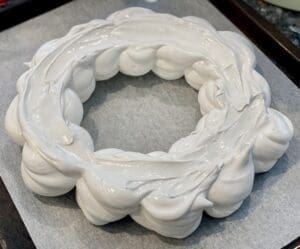
- Use a large, flat plate or cake board to carefully turn the pavlova upside down. Gently peel away the baking paper, then turn the pavlova upright again.Place the cream, icing sugar and vanilla extract into a large bowl and whisk using a stand or hand mixer until medium-firm peaks form. Spoon the whipped cream generously over the pavlova, then decorate with your choice of fresh fruit and a few sprigs of mint.
Notes
(NOTE 1) Eggs - I used 7 large eggs (approximately 58g / 2oz per egg). After separating them, the egg whites weighed 240g / 8.5oz in total. Eggs are much easier to separate when chilled, so I separate them straight from the fridge, then left the whites at room temperature for about 20–30 minutes (depending on how warm the day is).
(NOTE 2) Caster sugar (superfine sugar) - Caster sugar has finer granules than regular white sugar, but it’s not the same as powdered sugar. Many baking recipes call for caster sugar because it dissolves more quickly and evenly into mixtures. If you can’t find caster sugar, you can easily make your own by pulsing regular white sugar in a food processor or blender a few times until it looks finer. Take care not to over-process it, or it will turn into powdered sugar.
(NOTE 3) Thickened cream (whipping cream) - Thickened cream here has gelatine added to help it hold its shape and typically contains around 35% milk fat. For best results, whip the cream to medium to firm peaks so it holds its shape and supports the fruit topping.
(NOTE 4) Icing sugar (powdered sugar, confectionary sugar) - Icing sugar usually comes in two forms here: icing sugar mixture and pure icing sugar. Icing sugar mixture is softer and less prone to lumps because it contains added starch. For this recipe, I use icing sugar mixture, as the cornstarch helps stabilise the whipped cream.
Seasonal fruits – I know it's not summer globally during the Christmas holidays! So you may not be surrounded with fresh berries. Just swap with seasonal fruits, or use fruit compote like this simple and delicious Strawberry Compote.
I’ve used a third-party application to calculate the calories and nutritional information, so please treat this as an approximate guide only.
All cooking measurements are in Australian standard cups and spoons. For specific details and conversions, please visit my Australian Cooking Measurements page.
I’d love your feedback if you make this recipe. You can support my work by rating the recipe and leaving a comment — simply scroll to the comments section below or click the green circle in the bottom left corner. An email address is required to help prevent spam, but it will not be published.
I’d also love to see your creations, so don’t forget to tag me on Instagram @3catsfoodie
Cheers – Cat T
Nutrition
Serving: 1servingCalories: 410kcalCarbohydrates: 45gProtein: 4gFat: 17gSaturated Fat: 11gPolyunsaturated Fat: 1gMonounsaturated Fat: 4gCholesterol: 54mgSodium: 52mgPotassium: 85mgFiber: 0.01gSugar: 43gVitamin A: 700IUVitamin C: 0.3mgCalcium: 34mgIron: 0.1mg